
 USA
USA  Canada
  Germany
  France
  Italy
Italy  Switzerland
  Sweden
  Spain
Spain  Great Britain
  Norway
  Russia
  South Africa
  Japan
Japan  New Zealand
  Australia
You're ready to buy a two-piece motorcycle race suit, but you're not sure what actually separates a safe, well-fitting suit from one that will fail you on the track or street. Maybe you've tried on three different brands and they all felt different. Maybe you're wondering if the cheaper option will protect you the same way as the premium one. Maybe you're torn between standard sizing and custom fit, or you're not sure if a two-piece is even the right choice for how you ride.
The truth is that buying the wrong suit costs money, comfort, and potentially your safety. A suit that fits poorly can shift during a crash, leaving gaps where armor should be. Armor that doesn't meet your riding speed or track requirements won't protect you the way you need. Materials that look impressive on paper can fail in a real slide. This guide walks you through exactly what to check before you hand over your money — so you can buy with confidence and ride knowing your gear will perform when it matters.
Quick Buying Advice:
Before you buy a two-piece motorcycle race suit, prioritize fit first, then safety features, then construction quality. A two-piece suit works best if you ride sportbikes at track days, club races, or aggressive road speeds where you need protection but also want the flexibility to remove the jacket for pit breaks or cooler weather. Make sure the suit has CE Level 2 armor in the knees and hips (or Level 1 if you ride at lower speeds), reinforced seams with at least 3–4 mm stitch width, and leather thickness of 1.0–1.3 mm minimum. Most importantly, the suit must fit snugly when you're in your riding position — not when you're standing upright — with no gaps between the jacket and pants at the waist.
- What Should Riders Know Before Buying a Two-Piece Motorcycle Race Suit?
- How to Choose Gear Based on Your Riding Style
- What Safety Features Should Buyers Check?
- How Fit and Sizing Affect Comfort and Protection
- Which Materials and Construction Details Matter?
- Standard Size vs Custom Size: Which Should You Choose?
- Final Buying Advice from Leather Collection
What Should Riders Know Before Buying a Two-Piece Motorcycle Race Suit?
A two-piece motorcycle race suit is a jacket and pants combination designed to protect you during high-speed riding and track use. The two pieces connect via a full-length zipper, which means you can ride them together or remove the jacket separately if needed — unlike a one-piece suit, which stays connected. This flexibility is the main reason riders choose two-piece suits, but it also introduces a trade-off: the zipper connection is a weak point in protection if the pieces separate during a crash.
Two-piece suits are built for riders who spend time on track, race at club level, or ride aggressively on the street at sustained high speeds. They are not ideal for casual commuting or touring because they require more active management — you need to keep the zipper sealed, make sure the pieces don't shift, and accept that they're less convenient to put on and take off than a textile jacket.
The core decision before you buy is whether a two-piece suit matches your actual riding. A track-day rider who spends four hours in full race gear benefits from a two-piece because it offers excellent protection and allows a quick jacket removal during pit breaks. A street rider who occasionally pushes hard on weekend roads might be better served by a one-piece suit with simpler construction and no zipper to manage. A rider who wants maximum versatility — wearing the jacket alone on cool days or with different pants on warm days — should choose a two-piece. Be honest about which scenario describes you before you commit.
How to Choose Gear Based on Your Riding Style
Your riding style determines what features matter most in a two-piece suit. A club racer, a track-day rider, a sportbike enthusiast, and a street rider all have different needs — and buying gear designed for the wrong use case wastes money and leaves you underprotected.
If you race at club level or spend regular time at track days, you need a two-piece suit with CE Level 2 armor in the knees and hips, reinforced seams throughout, and leather that can withstand high-speed abrasion. You'll be sliding at speeds above 40 mph, and your armor and leather need to absorb that impact and resist tearing. You should also prioritize a suit with a secure waist connection — either a full-length zipper with locking tabs or mechanical fasteners that prevent the jacket and pants from separating on impact. The cost is higher, but the protection difference is real.
If you ride a sportbike aggressively on the street but don't spend much time on track, a two-piece suit with CE Level 1 armor in the knees and hips is often sufficient. You're riding at high speeds, but your crash speeds are typically lower than a track rider's because you're not pushing the limits of grip and braking. Level 1 armor still meets EN 1621-1 standards and will protect you significantly better than no armor, though it absorbs less impact energy than Level 2. You can save money here without compromising your actual safety needs.
If you're a beginner buying your first leather suit, focus on fit and comfort first. Many new riders buy expensive race suits that are designed for aggressive positioning, then find them fatiguing or restrictive for their actual riding style. Start with a suit that fits well in a neutral riding position, has CE armor in the knees and hips, and uses quality leather and seams. As you gain experience and understand your riding better, you can upgrade to a more specialized suit.
If you ride mostly on the street but want the option to take track days occasionally, a two-piece suit gives you flexibility. You can wear the jacket alone on cool commutes, then pair it with the race pants for track use. This is a legitimate use case, but make sure the jacket alone still provides protection — some race jackets are designed to work only as a connected pair.
What Safety Features Should Buyers Check?
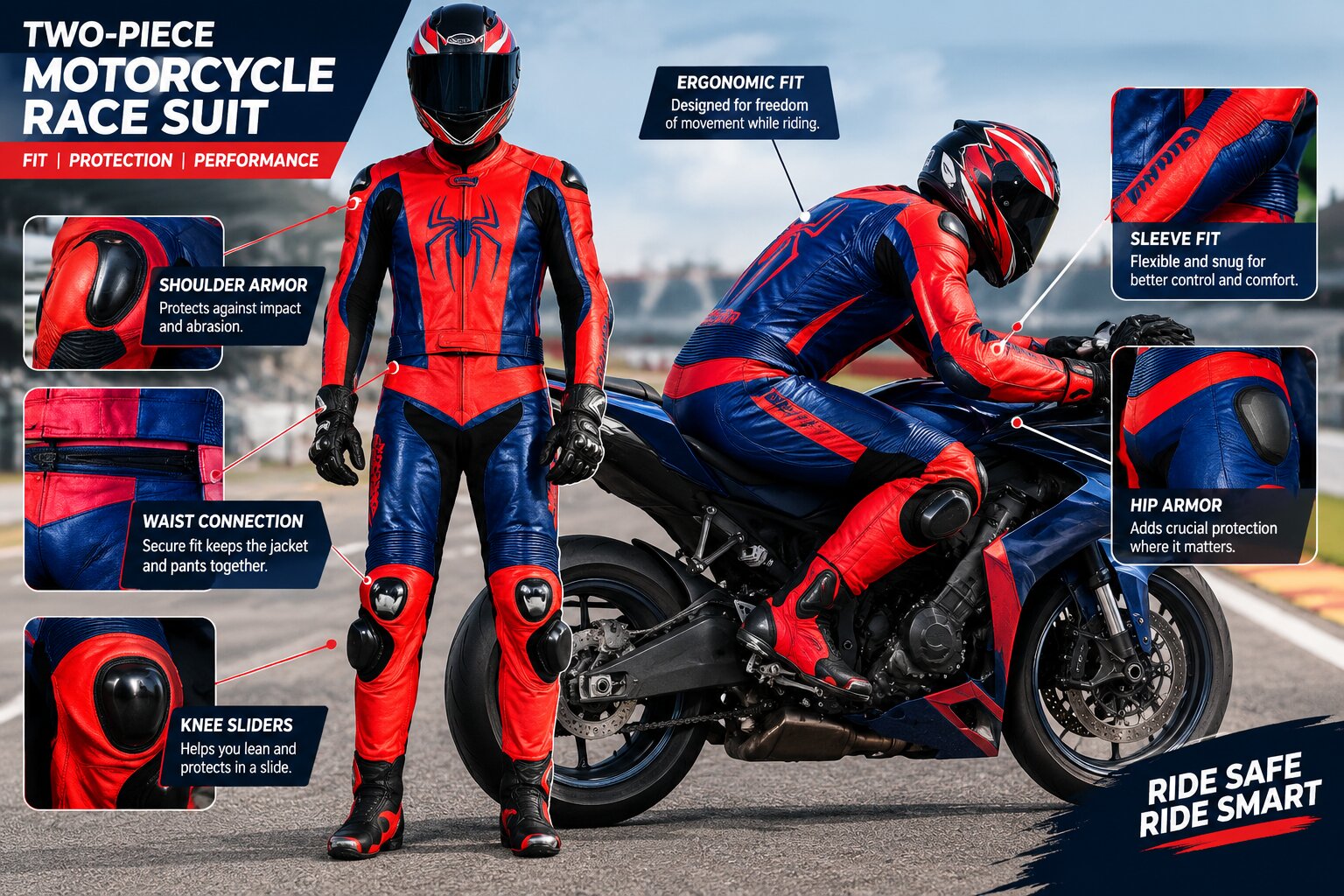
Safety features in a two-piece motorcycle race suit include armor certification, armor placement, seam reinforcement, leather thickness, and connection strength. Each of these directly affects how well the suit will protect you in a crash. Do not buy a suit based on how it looks or how the brand markets it. Check the actual specs.
Armor certification is the first thing to verify. Look for CE certification, which means the armor was tested to EN 1621-1 (Level 1) or EN 1621-2 (Level 2) standards. These standards define how much impact energy the armor absorbs under controlled test conditions. Level 2 armor absorbs more energy than Level 1, which matters if you crash at high speed. The test uses a pneumatic impact hammer to strike the armor at 50 joules (Level 1) or 60 joules (Level 2), and the armor must limit the force transmitted to the body below a specific threshold. In practical terms, Level 2 is better for track and aggressive riding; Level 1 is adequate for street riding at moderate speeds.
Armor placement matters as much as certification. Your knees and hips are the most common impact points in a motorcycle crash — they hit the ground first when you slide. Make sure the suit has armor in both locations. Some cheaper suits have armor only in the knees or only in one hip. Check that the armor is positioned correctly for your body size. Armor that sits too high or too low won't protect the impact zone. The back protector is optional for a two-piece suit, but if the suit includes one, verify it's CE certified and secured so it won't shift during a crash.
Seam reinforcement is critical because seams fail before leather does in a high-speed slide. Check the stitch width — the distance between the needle line and the edge of the leather. A stitch width of 3–4 mm is standard for race suits; anything less than 3 mm is weak. Look at the thread itself: polyester thread is standard, but some manufacturers use nylon or specialty blends that don't fray as easily. If you can see a seam that looks thin or loose, the suit is not built to race-suit standards.
Leather thickness is measured in millimeters. Most race suits use 1.0–1.3 mm cowhide or 0.8–1.1 mm kangaroo leather. Thicker leather provides more abrasion resistance but adds weight and reduces flexibility. Thinner leather is lighter and more comfortable but wears through faster in a slide. For track use, aim for at least 1.0 mm cowhide or 0.9 mm kangaroo. For street use, 0.9 mm cowhide is acceptable. Do not buy a suit made from leather thinner than 0.8 mm if you plan to ride at speeds above 30 mph.
Connection strength between the jacket and pants determines whether they stay together during a crash. The best two-piece suits use a full-length, heavy-gauge zipper with locking tabs on both sides. Some suits use mechanical fasteners like snap buttons in addition to the zipper. Test the zipper before you buy — it should feel smooth and solid, not loose or scratchy. A weak zipper is a liability because it can separate during a crash, leaving your lower back and waist unprotected.
How Fit and Sizing Affect Comfort and Protection
Fit is where most riders make their biggest mistake. A suit that fits perfectly when you're standing still will shift and bunch when you're in your riding position. This shift means armor moves away from impact zones, seams stretch and weaken, and gaps open up where protection should be solid. You must try on a suit while in your actual riding position — leaning forward, gripping handlebars, with your knees bent — not while standing upright.
When you're in your riding position, the jacket should be snug across your shoulders and upper back with no bunching or pulling. Your arms should move freely when you grip the handlebars — you should be able to reach forward without the jacket riding up on your back or restricting your shoulders. The waist should fit snugly with no gap between the jacket and pants. If you can fit more than one finger between the waist connection, the suit is too loose and will shift in a crash. The pants should sit comfortably on your hips without riding down or cutting into your thighs. Your knees should bend freely, and the armor should sit directly over your kneecap without sliding up or down when you move.
Length matters more than many riders realize. The jacket sleeves should reach your wrist when your arms are extended forward in riding position. If they're too short, your wrists and lower forearms are exposed. If they're too long, they bunch at your wrists and reduce mobility. The pants should reach your ankles without dragging on the ground. Dragging pants catch on pegs, shift during riding, and wear through at the heel.
A common mistake is buying a suit one size too large because it feels more comfortable when standing still. This is a false economy. A loose suit is less comfortable in your riding position because it bunches and moves. It's also less safe because armor shifts, seams experience more stress, and the suit doesn't stay in place during a crash. Fit tight enough that the suit feels like a second skin when you're in your riding position — not so tight that you can't move or breathe, but tight enough that it won't shift.
Another mistake is assuming that if a suit fits in the chest, it will fit everywhere. Two-piece suits have independent sizing for the jacket and pants, which is actually an advantage — you can buy a size 46 jacket with size 32 pants if your proportions require it. Many riders have a larger chest than their waist-to-hip ratio, or longer legs than their torso. Do not force yourself into a standard size if the proportions don't match your body. This is where custom sizing becomes valuable, but many riders can find a good fit by mixing jacket and pants sizes from the same brand.
Riders with non-standard proportions should consider custom sizing. If you're very tall with a short torso, or short with long legs, or have a large chest with narrow hips, standard sizes will never fit well. Custom sizing costs more upfront but saves money in the long run because you won't need to replace a poorly fitting suit. A custom suit will also protect you better because armor sits in the right place and the suit stays in position during riding.
Which Materials and Construction Details Matter?
The materials and construction details in a two-piece suit determine how long it will last, how well it protects you, and how comfortable it is to wear. Leather type, leather thickness, lining quality, zipper quality, and seam construction all affect real-world performance.
Leather type is the first material choice. Cowhide is the most common race-suit leather because it's durable, affordable, and widely available. It's typically 1.0–1.3 mm thick and provides excellent abrasion resistance. Kangaroo leather is lighter and stronger per millimeter than cowhide — a 0.9 mm kangaroo hide provides similar abrasion resistance to a 1.1 mm cowhide — but it costs more and is less commonly available. Some riders prefer kangaroo for its lighter weight and superior flex; others prefer cowhide for its affordability and familiarity. Both are legitimate choices. Avoid cheap leather that's painted or artificially finished to look premium — it won't age well or perform in a crash.
Lining quality affects comfort and durability. A high-quality lining is made from breathable mesh or perforated material that allows sweat to escape. Cheap lining traps moisture and causes discomfort on long rides. Check that the lining is stitched securely to the leather — if it's only glued, it will separate and bunch during wear. Some riders prefer removable linings for easier cleaning; others prefer fixed linings for durability. Both work, but removable linings add cost.
Zipper quality is often overlooked but matters significantly. A two-piece suit relies on its zipper to stay connected, so the zipper must be smooth, strong, and durable. Look for a heavy-gauge zipper with a locking slider — this prevents accidental opening during riding. Some manufacturers use zippers with double-sided locking tabs that prevent separation even if the slider fails. Test the zipper before you buy. It should slide smoothly without grinding or catching. A zipper that feels scratchy or loose will fail.
Seam construction determines how well the suit holds together in a crash. The best race suits use flat-felled seams, which overlap and fold the leather for maximum strength. Standard seams are simpler but still effective if the stitch width is 3–4 mm. Check that seams are reinforced in high-stress areas like the shoulders, elbows, and waist connection. Some suits add extra stitching or tape reinforcement in these areas, which is a sign of quality construction.
When is it worth paying more? Premium two-piece suits cost significantly more than entry-level options, but the difference comes from better materials, better fit options, and better construction. If you ride regularly at track days or race, a premium suit will last longer, fit better, and protect you better. If you ride occasionally, an entry-level suit with good basic specs will serve you well. The real question is not whether to buy the most expensive option, but whether the suit you're considering has the specific features you need. A mid-range suit with CE Level 2 armor, quality leather, and reinforced seams will protect you better than a premium suit with Level 1 armor and thinner leather, regardless of price.
Standard Size vs Custom Size: Which Should You Choose?
Most riders fit into standard sizes and should buy standard first. Standard sizing is faster to receive, less expensive, and comes with established fit feedback from other riders who wear the same size. If you can find a standard size that fits well in your riding position, that's your best option.
Custom sizing makes sense if standard sizes don't fit your body proportions. Some examples: if you're 6'2" with a 34" waist (very long torso relative to waist), standard sizes will leave you with pants that are too short or a jacket that's too loose. If you're 5'4" with a 40" chest (short with broad shoulders), standard sizes will bunch at your waist and be too long. If you have one arm significantly longer than the other due to injury or genetics, custom sizing can accommodate that.
The cost difference is real. A standard two-piece suit typically costs 20–30% less than a custom suit from the same manufacturer. However, if you buy a standard suit that doesn't fit and then have to replace it, custom sizing becomes the cheaper option. Before you commit to custom, try on standard sizes from multiple brands. Different manufacturers cut their suits differently — a size 48 from one brand might fit very differently from a size 48 from another. You may find a good fit in standard sizing if you're willing to compare options.
The timeline matters too. Standard suits ship in 2–4 weeks. Custom suits take 6–12 weeks because they're made to order. If you need gear for an upcoming track day, standard sizing is your only option. If you have time and your proportions fall outside standard ranges, custom is worth the wait.
Final Buying Advice from Leather Collection
Before you buy a two-piece motorcycle race suit, make three decisions in order: first, confirm that a two-piece suit matches your riding style and needs; second, find a suit that fits correctly in your riding position with proper armor placement; third, verify that the construction quality and materials will hold up to your riding.
The most common buying mistakes are choosing the wrong size because it feels comfortable standing still, skipping the armor check because you trust the brand name, and paying for premium features you don't actually need. Avoid all three by trying on the suit in your riding position, checking the armor certification and placement yourself, and being honest about what features matter for your actual riding.
Riders who want better protection for track and aggressive street riding can explore our
for gear designed around safety, fit, and high-performance riding comfort.Once you've narrowed down to a specific suit, verify the return policy. Most quality manufacturers offer a 30-day return window if the fit doesn't work out. Use that window to ride in the suit, not just to try it on. A suit that feels good in the shop might feel different on a real ride. If it doesn't feel right, return it and try another size or brand. This is not wasted time — it's the only way to find gear that will actually protect you and keep you comfortable.
For riders comparing real protective gear, the
shows how armor placement, reinforced construction, and fit work together in a suit designed for track and race use.Your final step is to buy from a retailer who understands fit and can help you with sizing questions. Do not buy from a retailer who won't answer questions about armor placement, leather thickness, or construction details. A good retailer will ask about your riding style, your body proportions, and your previous gear experience. They should be able to recommend a suit based on your actual needs, not the suit they have in stock.
FAQs
What's the difference between a two-piece and one-piece motorcycle race suit?
A two-piece suit is a separate jacket and pants connected by a zipper, allowing you to remove the jacket for pit breaks or wear the pieces separately. A one-piece suit is permanently connected, offering simpler construction and no zipper weak point, but less flexibility. Two-piece suits are better for riders who want versatility; one-piece suits are better for riders who prioritize maximum protection with no gaps or weak points.
Do I need CE Level 2 armor or is Level 1 enough?
CE Level 2 armor absorbs more impact energy than Level 1 under EN 1621 test conditions, making it better for high-speed crashes. If you ride at track days, race, or regularly exceed 50 mph on the street, Level 2 is worth the investment. If you ride at moderate street speeds below 40 mph, Level 1 is adequate. Check the actual armor in your suit — some manufacturers claim Level 2 but install Level 1 armor to save cost.
How tight should a two-piece race suit fit?
A two-piece suit should fit snugly in your riding position with no more than one finger of space at the waist connection. When standing still, it may feel tight or restrictive, but this tightness prevents shifting during a crash. If you can move your arms and legs freely in your riding position and the armor sits directly over your knees and hips, the fit is correct. A loose suit is less safe and less comfortable than a properly fitted tight suit.
What leather thickness do I need for track riding?
For track riding, use at least 1.0 mm cowhide or 0.9 mm kangaroo leather. These thicknesses provide sufficient abrasion resistance to protect you through a high-speed slide. Anything thinner than 0.8 mm will wear through too quickly and won't protect you adequately. Thicker leather (1.2–1.3 mm) offers more protection but adds weight and reduces flexibility — it's a trade-off between safety and comfort.
Can I wear a two-piece race suit for street riding, or is it only for track?
You can wear a two-piece race suit for street riding if you keep the zipper sealed and maintain proper fit. However, a two-piece suit requires more active management than a textile jacket or a one-piece suit. If you want the flexibility to remove the jacket separately, a two-piece is ideal. If you want simpler, more convenient gear for commuting, a textile jacket or one-piece suit is better.
Should I buy custom sizing or try standard sizes first?
Try standard sizes first — they're cheaper, faster to receive, and work for most riders. Custom sizing makes sense only if you've tried multiple standard sizes and none fit your proportions. If you're significantly taller or shorter than average, have a large chest with narrow hips, or have other non-standard proportions, custom sizing will be worth the extra cost and wait time.
What should I check before I actually buy a two-piece race suit?
Check the armor certification (CE Level 1 or 2), armor placement (knees and hips), leather thickness (minimum 0.9 mm), seam width (minimum 3 mm), zipper quality (smooth and lockable), and fit in your riding position (snug at the waist with no gaps). Try on the suit while leaning forward and gripping handlebars, not while standing upright. Verify the return policy in case the fit doesn't work out after a real ride.